ChordEdit: One-Step Low-Energy Transport
for Image Editing

Abstract
The advent of one-step text-to-image (T2I) models offers unprecedented synthesis speed. However, their application to text-guided image editing remains severely hampered, as forcing existing training-free editors into a single inference step fails. This failure manifests as severe object distortion and a critical loss of consistency in non-edited regions, resulting from the high-energy, erratic trajectories produced by naive vector arithmetic on the models' structured fields. To address this problem, we introduce ChordEdit, a model agnostic, training-free, and inversion-free method that facilitates high-fidelity one-step editing. We recast editing as a transport problem between the source and target distributions defined by the source and target text prompts. Leveraging dynamic optimal transport theory, we derive a principled, low-energy control strategy. This strategy yields a smoothed, variance-reduced editing field that is inherently stable, facilitating the field to be traversed in a single, large integration step. A theoretically grounded and experimentally validated approach allows ChordEdit to deliver fast, lightweight and precise edits, finally achieving true real-time editing on these challenging models.
Methodology
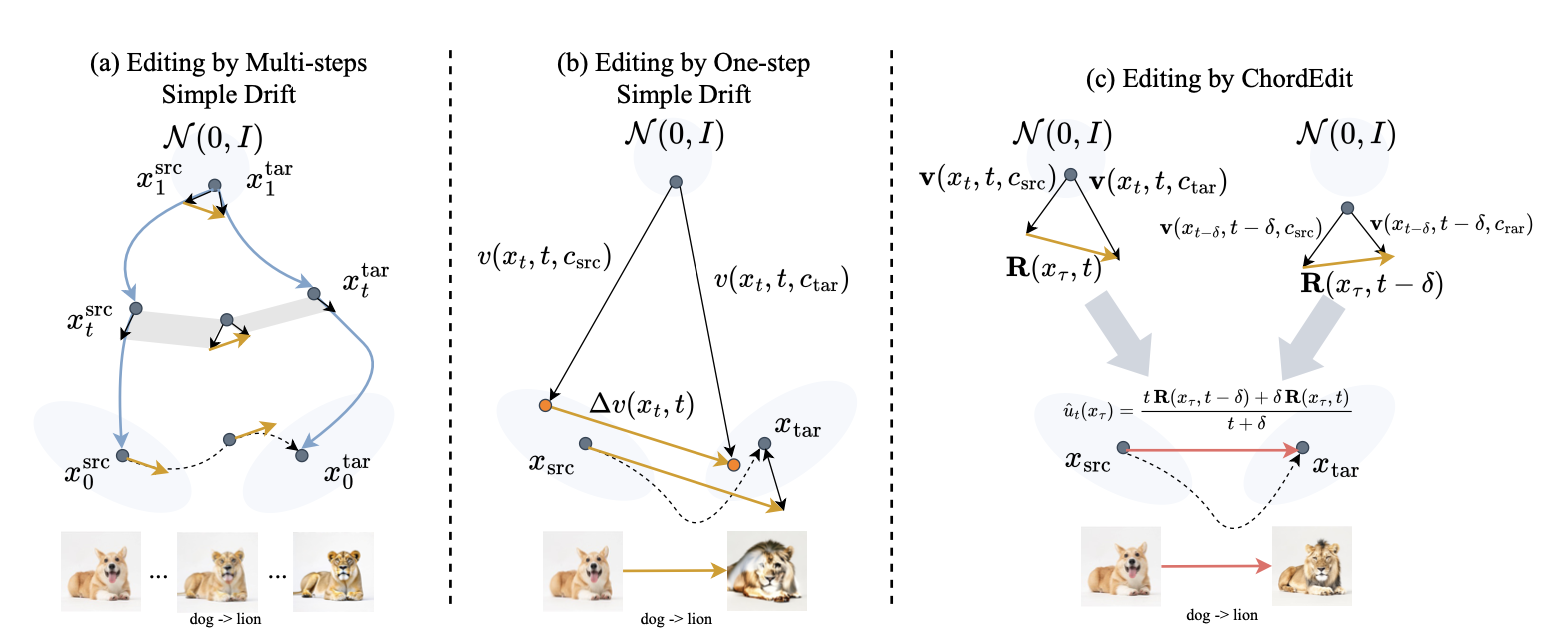
Existing training-free methods fail in one-step settings because the naive drift difference creates a high-energy, erratic trajectory. When integrated in a single step, this leads to significant error accumulation.
Chord Control Field
Our key contribution is the Chord Control Field, a theoretically-grounded, time-weighted average of the source and target drifts. This acts as a temporal smoothing operator, yielding an inherently stable, low-energy field.
Results
Qualitative Comparison
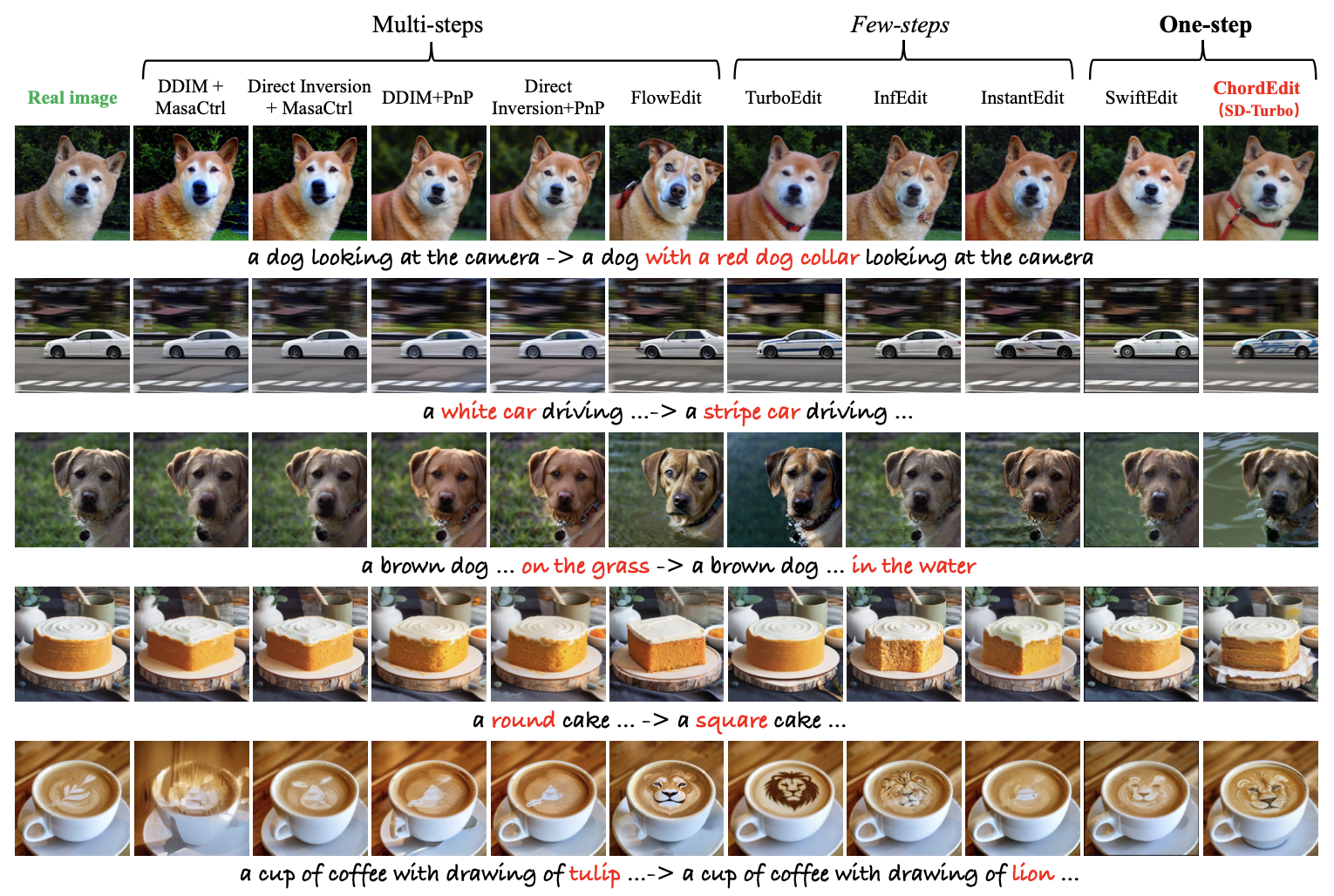
We compare ChordEdit with state-of-the-art multi-step, few-step, and one-step editors. ChordEdit consistently adheres to the prompt with exceptional background preservation, avoiding artifacts or identity failures seen in other methods.
Ablation Study: Energy Analysis
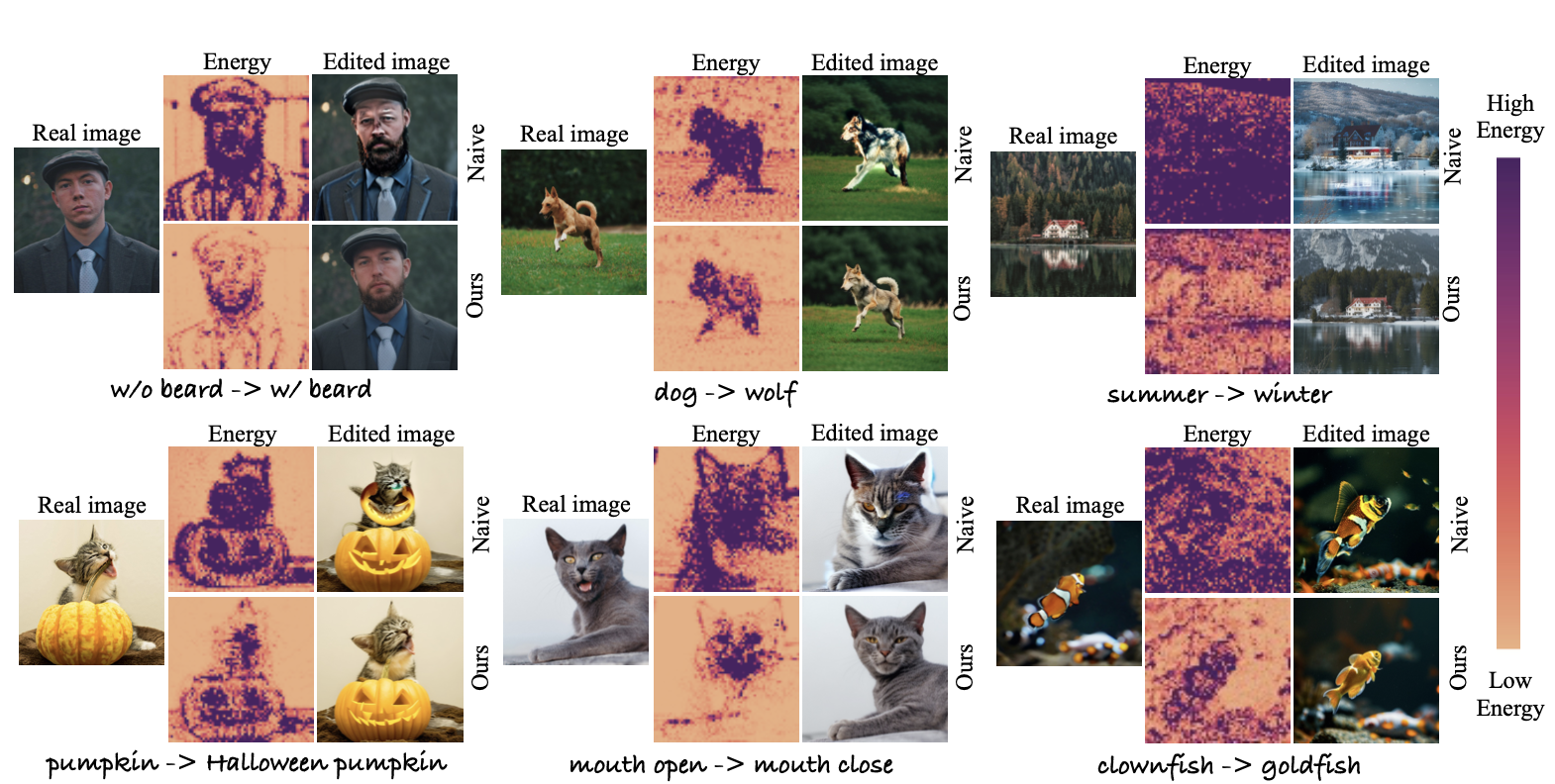
To validate the stability of our method, we visualize the energy of the editing fields. The Naive baseline exhibits high-energy spikes, leading to severe artifacts and background corruption. In contrast, ChordEdit derives a stable, low-energy field, resulting in high-fidelity edits that preserve object identity and non-edited regions.
BibTeX
@misc{lu2026chordedit,
      title={ChordEdit: One-Step Low-Energy Transport for Image Editing},
      author={Liangsi Lu and Xuhang Chen and Minzhe Guo and Shichu Li and Jingchao Wang and Yang Shi},
      year={2026},
      eprint={2602.19083},
      archivePrefix={arXiv},
      primaryClass={cs.CV},
      url={https://arxiv.org/abs/2602.19083},
}